Problem statement
Pet parents need a clear way to organize recurring care because remembering appointments, records and supplies can feel like another responsibility to carry.
03 / COMPANION CARE · INDEPENDENT PROTOTYPE
Companion Care Hub
Bring pet care into one place, so remembering what comes next feels less like a burden.
From concept to a testable experience. Created and built independently with AI assistance. Competitive desk research is documented below; no participant research or usability testing has been completed.
Founder-defined problem framing, to validate with pet parents.
Pet parents need a clear way to organize recurring care because remembering appointments, records and supplies can feel like another responsibility to carry.
A household overview connects each pet’s profile to routine scheduling, upcoming appointments, records and care support.
Help pet parents see what needs attention and plan the next step in one place, with controllable reminders that support their routines.
If pet profiles, care schedules and reminder preferences share one clear experience, pet parents will organize routine care with fewer source switches and greater confidence than with their current approach.
Make the next care task obvious without overwhelming the user?
Keep multiple pets’ needs distinct and easy to recognize?
Offer reassurance through reminders while preserving user control?
The supplied prototype explores nine destinations. The design challenge is to make that breadth feel manageable.
Pet profiles anchor the home screen, with upcoming appointments and supplies nearby. Recognition should replace remembering where information lives.
Profiles, routine health and records use pet selection to distinguish needs. Test whether the selected pet remains clear throughout each task.
Routine care can create calendar entries; the booking flow exposes reminder choices. Confirmation must distinguish a saved plan from a provider-confirmed visit.
High contrast, larger text, speech features and notification preferences are included in the design. Accessibility effectiveness remains to be tested.
Profiles · routine health · monthly calendar
Records · local service directory · regional demo alerts
Sitter discovery · supplies · accessibility settings
Prototype scope. Pet and care data persist in this browser. Provider listings and health bulletins use sample data; bookings, push/SMS/email delivery, cloud sharing and supply orders are demonstrations, not connected production services.
Desk research · 8 October 2026. Two direct care-management competitors and two adjacent service benchmarks, reviewed through public web and US App Store listings.
| Product / relationship | Documented strengths | Implication for PetParent |
|---|---|---|
| 11pets Direct · care managementApp Store listing | Medication reminders, appointments, health tracking and veterinary record sharing. | Centralized care is an established expectation. Test PetParent’s setup effort and retrieval clarity rather than claiming an untouched market. |
| DogLog Direct · routine coordinationApp Store listing · Official site | Activity logging, reminders, multi-pet tracking and coordination across caregivers. | A care log and reliable handoffs set a strong benchmark. Shared household coordination is an opportunity to evaluate; it is not implemented in PetParent. |
| PetDesk Adjacent · provider coordinationApp Store listing | Appointment requests, calendar reminders, provider contacts and medication refill requests. | Separate requested, scheduled and confirmed states. PetParent’s simulated booking feedback needs refinement before provider integration. |
| Rover Adjacent · sitter marketplaceApp Store listing | Local sitter discovery, bookings, messaging and visit updates. | Sitter trust and availability require real verification. PetParent’s sample directory does not establish a vetted marketplace. |
Baseline
Reminders and records already overlap with existing products.
Design opportunity
Reduce navigation and setup effort across routine care tasks.
Scope decision
Validate care planning before expanding the service ecosystem.
Compared advertised task coverage, coordination model and service dependencies. Products were not installed or tested; absence from a listing is not evidence that a feature is missing. Prices and ratings vary by market and were excluded from the comparison.
Selected App Store reviews raise questions worth testing: a DogLog reviewer described difficulty distinguishing pets in a combined feed (August 2023), and an 11pets reviewer reported record-upload trouble. These are anecdotal signals, not representative findings or verified current defects.
Implications are design interpretations. No evidence yet establishes that PetParent is easier to use or reduces missed care.
Source-derived navigation, with nine top-level destinations and shared scheduling paths.
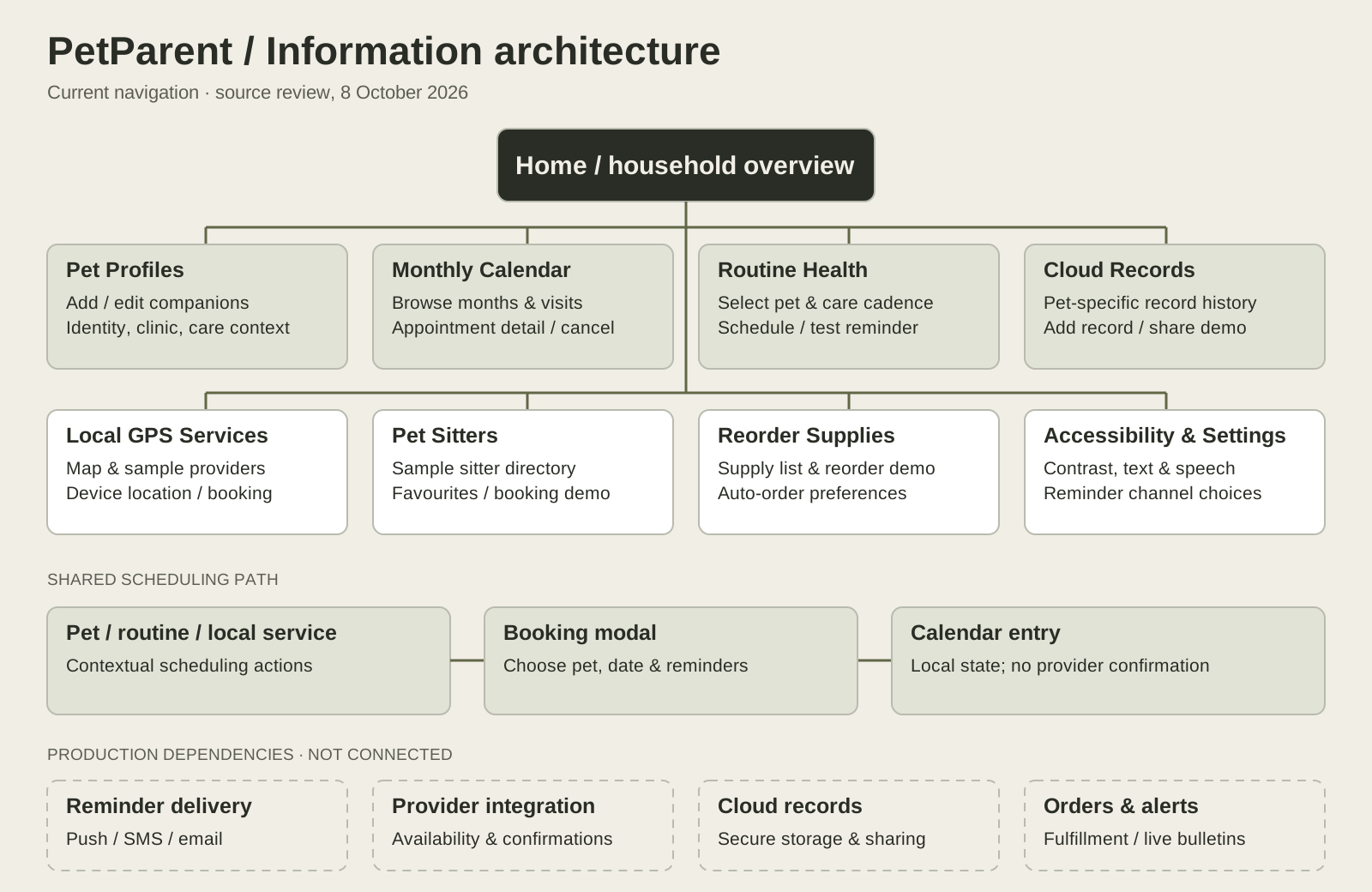
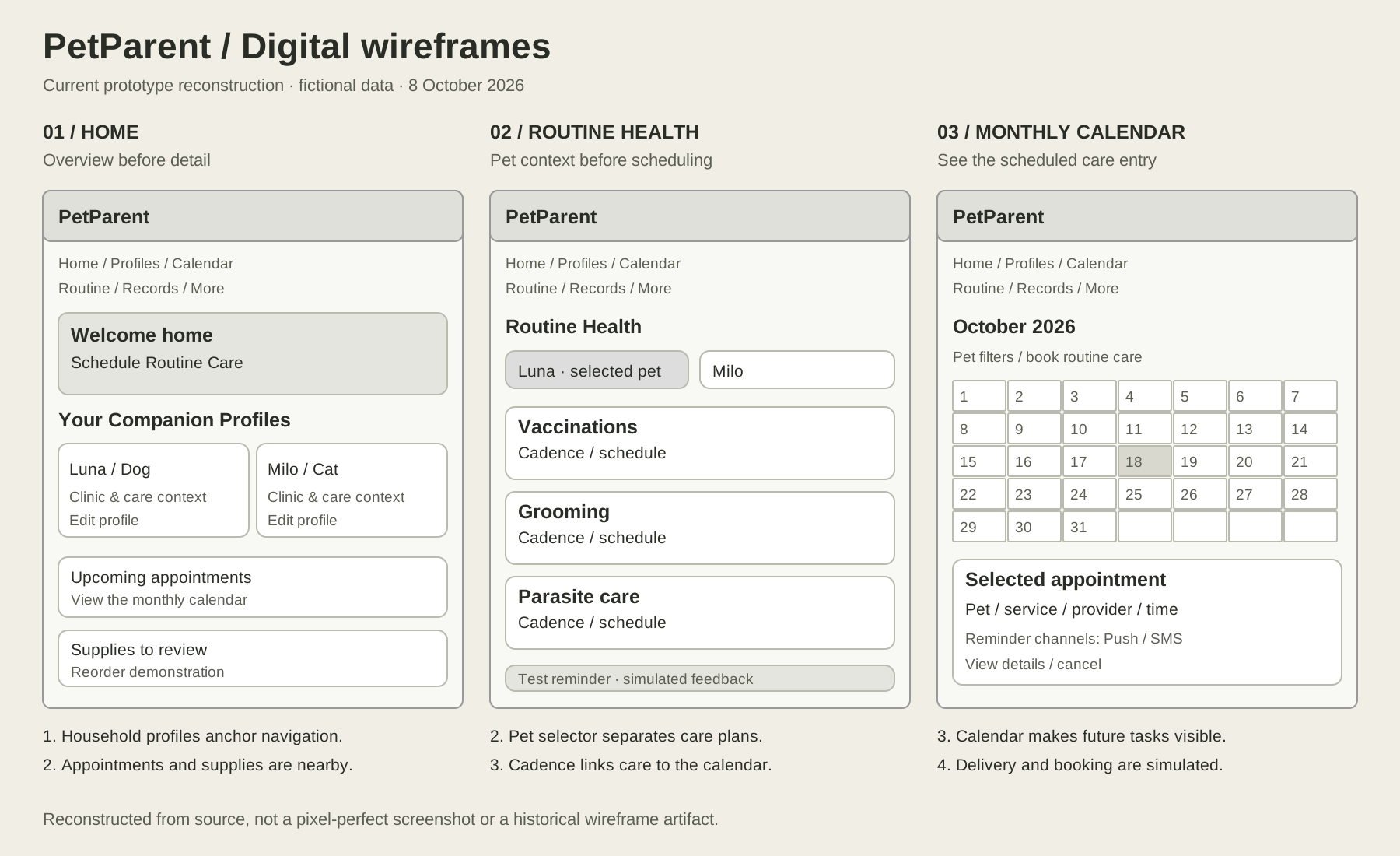
Iteration question: can contextual actions make nine destinations feel simple, or would a smaller task-based navigation model improve findability? Test before restructuring.
Assumption-based profiles, not research participants. Validate these jobs to be done before treating them as personas.
JTBD: Know what is coming up around a changing schedule.
Friction hypothesis: Care tasks compete with everyday responsibilities.
User story: As a busy pet parent, I want a clear schedule and controllable reminders so I can plan care without relying on memory.
JTBD: Organize different routines for each companion.
Friction hypothesis: Similar tasks are easy to attribute to the wrong pet.
User story: As a multi-pet owner, I want every appointment linked visibly to a pet so I can avoid mixing up care plans.
JTBD: Retrieve information and manage care using a preferred access method.
Friction hypothesis: Dense controls and small text make planning harder.
User story: As a pet parent with visual or motor access needs, I want readable controls and clear navigation so I can manage care independently.
Research question: which care tasks create the most mental load, and does a single hub improve planning enough to earn ongoing use?
Recruit 6–8 pet parents with single and multiple pets, varied care routines and access needs. Use 30–45 minute interviews to map their current tools, workarounds and reminder preferences.
Invite 4–6 to a voluntary seven-day diary of planning effort and task handoffs. Use card sorting to explore how they group care tasks and interpret navigation labels.
Affinity-map evidence; refine JTBD and personas. Prioritize by frequency, effort and consequence. Decide whether records, supplies or service discovery belong in the first release.
Walk me through the last time you arranged routine care. Where did you store the date or record? What happened when plans changed? Which reminders help, and which do you ignore? How do you distinguish pets or hand care to someone else?
Use voluntary informed consent, fictional prototype data and recording opt-in with a notes-only alternative. Do not collect pet medical documents or account credentials. Anonymize findings; store recruitment contacts separately, delete recordings within 30 days after synthesis, and seek separate permission for portfolio use.
Proposed acceptance criteria, not outcomes. Small qualitative samples identify friction; they do not establish population-level improvements.
After real reminder delivery is implemented, propose a two-week pilot with 8–10 consenting pet parents to assess reminder usefulness, ignored alerts and perceived planning effort. This pilot has not been conducted.
Separately verify time zones, recurrence, duplicate prevention, delivery failures, denied permissions, data recovery, record access and provider status in staging. Test keyboard focus, screen-reader announcements, 200% zoom, contrast and reduced motion; current controls do not constitute a verified accessibility conformance claim.
Delivered: an independent interactive prototype with browser-persisted care data and documented navigation. User confidence, reduced mental load and fewer missed tasks remain unmeasured.
Source review: PetParent export dated 8 October 2026, including Home, Profiles, Calendar, Routine Care, Records, Services, Sitters, Supplies and Settings. Creator role and problem statement supplied by Damon Medwin. Desk research was added after the prototype build.
The supplied AI Studio link could not be opened successfully during review, so it is not presented as a working public demo. Browser persistence is verified in the source; cloud storage, actual SMS/push/email delivery, provider bookings, vetted sitters and fulfillment are not implemented in the supplied files. Health recommendations and alerts are sample content, not validated guidance.
Listings describe developer-advertised features. Personas, hypotheses, research activities, test samples and success targets are proposed; no user findings or measured results are claimed.