Initial task
Review today’s schedule, record a dose and check or correct its history.
02 / MEDICATION ROUTINES · INDEPENDENT PROTOTYPE
Make the next step clear.
Make the record understandable.
A medication companion exploring daily routines, dose records and refill planning. An exploratory user study now identifies priorities for the next prototype iteration.
Evidence to date: 21 completed survey responses and an existing interactive prototype. The prototype screens were captured on 8 October 2026; the research report is dated 13 October 2026. The findings guide the next iteration. Usability, accessibility outcomes and medication-adherence improvements remain unvalidated.
Explore the prototypeI originated Dose as a way to make planned medication routines and recorded actions easier to understand. The initial concept explored schedules, dose history and optional support; survey findings sharpen the priorities for reminders and refill planning.
Review today’s schedule, record a dose and check or correct its history.
Separating planned doses from recorded actions may clarify what happened. The survey now provides a reason to test this: 14/20 respondents rely on recall to check a dose.
Support a personal routine. Clinical guidance, dependable notifications and secure shared access require separate validation; the survey does not establish their effectiveness.
Today, Medications, History and Profile document the existing prototype’s structure. Use this baseline to explore the research priorities in the next wireframing pass: habit-based reminders, a quick dose-history check and a refill overview.
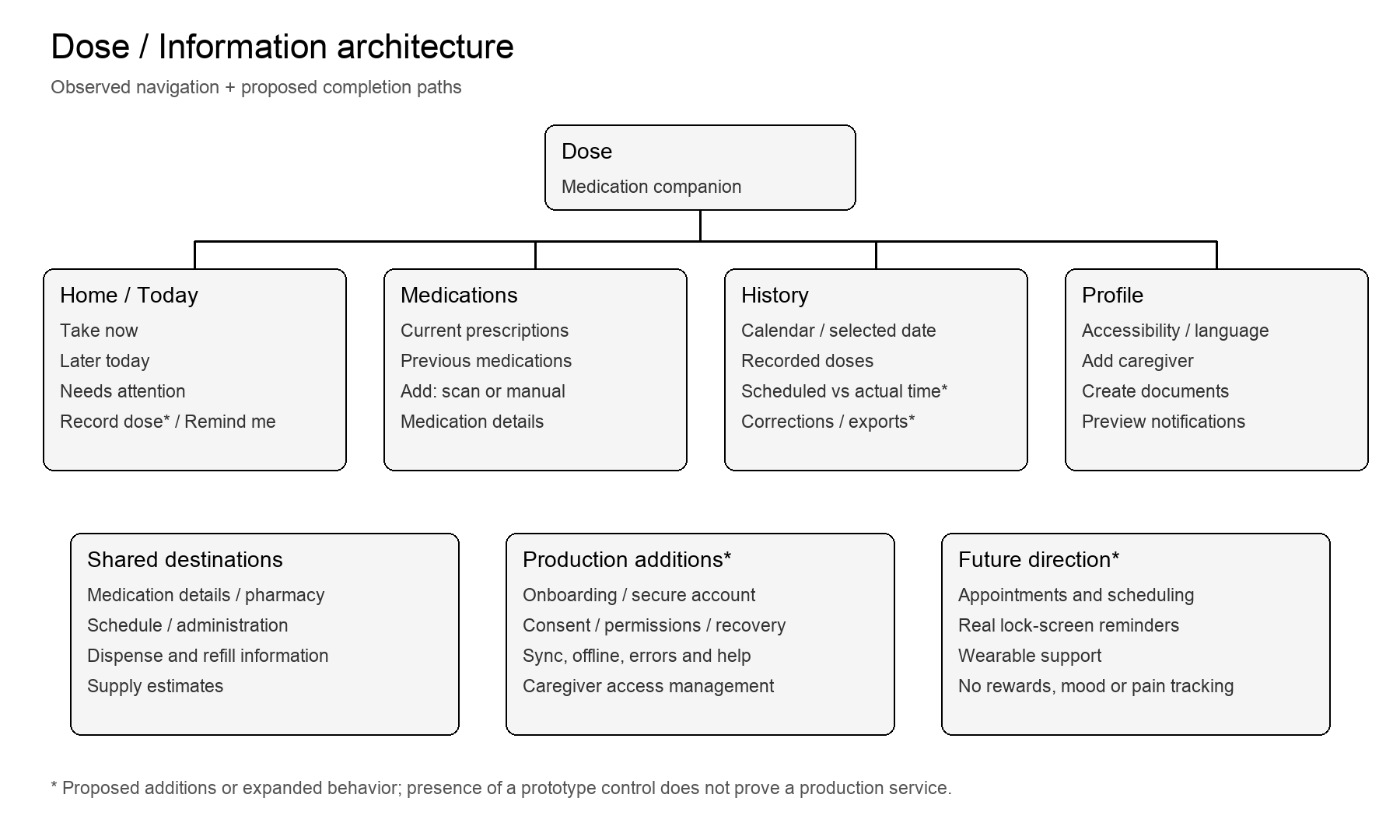
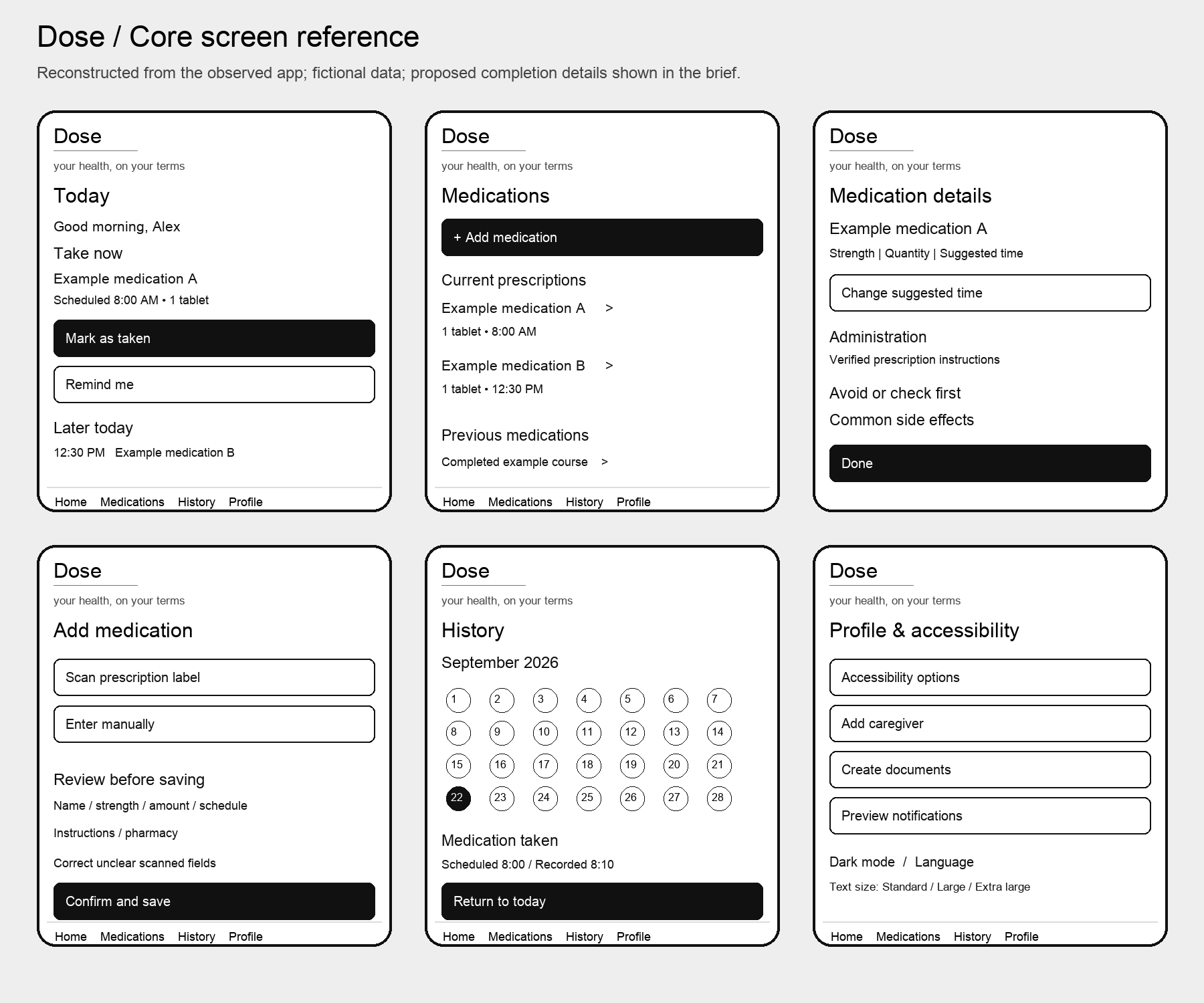
Wireframing status: the available materials document structure and a reconstructed reference. Original low-fidelity wireframes and a completed iteration based on this survey are not evidenced here.
The AI-built prototype makes the core review → record → history flow tangible. These captures use fictional study data and were taken on 8 October 2026, before the 13 October research report. They form a baseline for testing the needs identified in the survey.
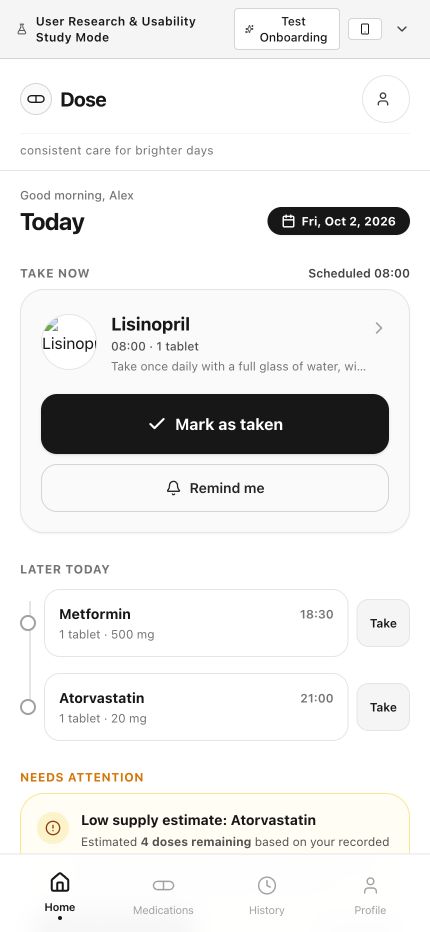
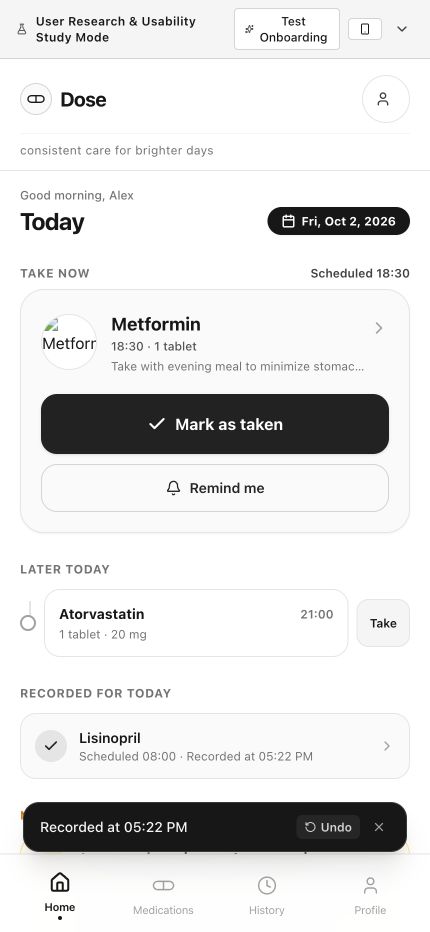
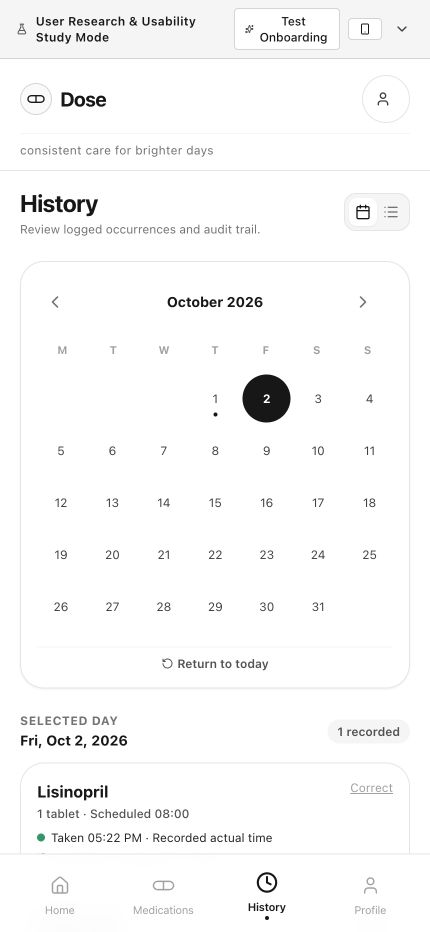
The screens show existing interface states, not participant test results. The survey supports testing dose confirmation but does not validate this flow. Medication imagery did not load consistently during capture; these images retain that state.
The survey identifies needs; these tests will assess whether the interface meets them.
Evidence: 15/20 tie doses to a daily activity; 7/14 difficulty responses describe timing, forgetting or tracking.
Next test: Compare routine-based reminders with the existing daily grouping, including changed schedules and midday doses.
Evidence: 14/20 rely on recall to check whether a dose was taken.
Existing baseline: Recording, Undo and history with planned and recorded times.
Next test: Confirm a recent dose and correct a mistaken entry; measure uncertainty, task success and logging effort.
Evidence: 19/20 refill when supply looks low; 5/14 difficulty responses describe refill logistics.
Next test: Prototype a refill overview and editable supply estimates. Check whether people notice upcoming refills and correct errors.
Evidence: Six of 18 travel responses mention an organizer; 12/21 report no current help from others.
Next test: Include organizer users and people using no app. Evaluate optional support, keyboard access, screen readers and text enlargement separately.
Dose now combines an AI-built interactive prototype with an exploratory user study: 21 completed survey responses, synthesized in the 13 October 2026 report. I originated the concept, inspiration and research collection; AI produced the app and interface build.
A working exploration of schedules, dose recording, correction and history, with documented navigation and interface captures.
Respondents rely on routines and memory. Timing disruptions and refill logistics recur in written answers. These findings prioritize habit-based reminders, visible dose history and refill planning.
A revised flow that meets those needs with little effort. The survey has not established usability, app demand, accessibility outcomes or improved medication adherence.
The research is exploratory and question-level samples vary. The screenshots predate the report; a completed research-informed redesign or usability-tested improvement is not claimed.
An exploratory survey produced 21 completed responses and 4 incomplete records. The 13 October 2026 report describes existing habits and difficulties; it is not a usability test of Dose. Question-level samples vary. These three slides connect the findings to priorities for the next iteration.
Exploratory convenience sample, mostly recruited through social media. Findings describe these respondents; they are not representative of Canada.
view detailed report21 completed survey responses shaped 14 priorities for the next Dose prototype.
forgot at least one dose
in the past 30 days13 / 20 respondents
Dedicated missed-dose support points to stored prescription instructions or a pharmacy.
Exact time + Undo on Home.
A fast, chronological “Did I take it?” history.
Waking, meals and bedtime groups.
Keep the clock time visible.
Separate dates + correctable supply estimates.
Optional alerts before supply runs out.
Adjust today only; tomorrow stays usual.
Distinguish late, skipped and taken doses.
55% consult labels first (11 / 20).
Keep label details + pharmacy contacts nearby.
Make logging quick and optional.
Optional, permission-based support access.
Support complex regimens and refill dates.
Preserve accessibility and existing features.
Source: Medication Research Report · 13 Oct 2026 · 21 completed responses; percentage questions n=20.
Exploratory findings inform design priorities. Usability and clinical outcomes remain unvalidated.
Phase Two · Planned
Planned: bring the research-informed changes into a second prototype. Screens and an updated prototype link will be added when available.
The exploratory survey is complete for this report. The next phase is to clarify the findings, wireframe the priority flows, update the prototype and run usability sessions. These are planned activities, not completed results.
Follow up with 6–8 adults with varied routines, digital confidence and access needs. Explore reminder timing, recent-dose checks and refill coordination. Sketch alternatives before refining the interface.
Use fictional medication data to test dose confirmation and correction, upcoming refills, editable estimates, travel and a busy midday schedule. Include organizer users and people who currently use no app.
Record task success, uncertainty, logging burden and refill-estimate corrections. Prioritize observed failures, retest changes and document what improved and what remains unresolved.
These questions assess the proposed experience; they are not measured outcomes or clinical claims.
Check contrast, keyboard order, visible focus, screen-reader labels and state announcements, 200% text enlargement, reduced motion and touch targets. Include participants who use relevant access methods where possible.
Validate support-person permissions, consent, revocation and editing separately. Verify reminder delivery, time handling, offline behaviour and recovery independently of interface appearance. The survey does not demonstrate demand for pharmacy integration.
For missed doses, test a clear status and access to existing prescription instructions or pharmacist contact. Do not infer a universal dosing or rescheduling rule from reported behaviours.
Document recruitment, participant counts, tasks and limitations. A before-and-after claim will require an observed iteration and retest; no improved adherence or lower error rate has been measured.
Phase Three · Planned
Planned: test the revised experience with users. Tasks, observations and findings will be added after the sessions.
Phase Three · Planned
Planned: refine the experience in response to usability testing. This slide will document the changes and what prompted them.
Phase Three · Planned
Planned: bring the usability-informed changes into a third prototype. Screens and an updated prototype link will be added when available.